
When it comes to FRP (Fiberglass Reinforced Plastic) roofing sheets, light transmission is one of the most critical performance factors for buyers to understand. Whether you‘re designing an industrial warehouse, a commercial skylight system, or an agricultural greenhouse, the amount of natural light that passes through your roofing material directly impacts energy costs, worker comfort, and even crop yields.
But here’s what many buyers don‘t realize: the light transmission of an FRP roofing sheet is not a fixed property—it’s a carefully engineered result of the raw materials and manufacturing process used. Different resin formulations, fiberglass content, and production techniques create different levels of transparency, each suited to specific applications.
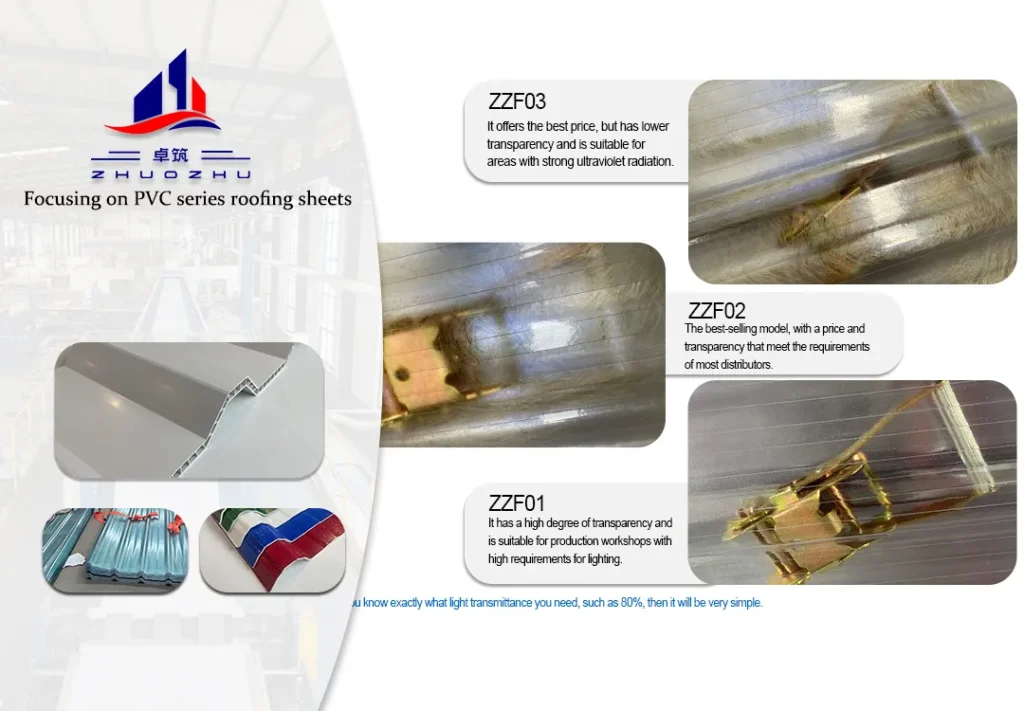
At ZHUOZHU, we manufacture FRP roofing sheets in three distinct light transmission grades to meet diverse project requirements. Here‘s everything you need to know about how we achieve these different transparency levels—and which one is right for your project.
What Determines FRP Sheet Transparency?
FRP sheets are composite materials made by combining thermoset resins with glass fiber reinforcement. The transparency of the final product depends on several interrelated factors:
1. Resin Type and Formulation
The resin is the matrix that binds the glass fibers together. Different resin types have different optical properties. Polyester resins are the most commonly used in FRP roofing sheets and can offer good transparency. However, the specific formulation—including additives, UV stabilizers, and colorants—significantly affects how light passes through the material. Some resins cure to a nearly colorless, transparent state, while others are formulated to create a diffused or opaque effect.
The refractive index of the cured resin must closely match that of the glass fibers to minimize light scattering at the interface between the two materials. When the refractive indices are mismatched, light bends and scatters as it passes through, reducing overall transparency.
2. Fiberglass Content and Orientation
The amount of glass fibers in the sheet and how they are arranged have a direct impact on light transmission. Higher fiber content scatters more light, reducing transparency. The type of glass fiber used—E-glass, C-glass, or others—also affects optical properties. Premium FRP sheets typically use alkali-free glass fibers for optimal clarity.
Manufacturers can control light transmission by adjusting the fiber-to-resin ratio. A typical translucent FRP sheet might contain approximately 30-35% fiberglass content by weight. Higher fiber content (40-50% or more) produces a stronger but less transparent sheet, while lower fiber content allows more light to pass through.
3. Manufacturing Process
The production method also influences transparency. Continuous lamination and pultrusion processes can create more consistent products with better optical properties. In the continuous molding process, resin is metered onto a carrier film, glass fibers are chopped and distributed, and the composite passes through wetting stations to remove air bubbles and ensure uniform impregnation. The curing process—typically in a temperature-controlled oven—must achieve a curing degree of over 90% for optimal clarity and aging resistance.
4. Thickness and Color
Thicker sheets generally transmit less light than thinner sheets of the same formulation. Similarly, darker colors absorb more light and reduce transmission. For transparent FRP sheets, light transmittance decreases as thickness increases.
ZHUOZHU FRP Roofing Sheet Light Transmission Grades
Based on our proprietary resin formulations and manufacturing parameters, ZHUOZHU offers FRP roofing sheets in three standard light transmission grades:
ZZF01 – High Transparency (80% Light Transmission)
| Parameter | Specification |
|---|---|
| Grade | ZZF01 |
| Light Transmission | ~80% |
| Characteristics | High clarity, near-glass transparency with soft diffused light |
ZZF01 is our highest-transparency grade, achieving approximately 80% light transmission. This grade uses a specially formulated clear resin with a precisely controlled fiberglass content and orientation to maximize light passage while maintaining structural integrity.
Applications:
- Industrial factory buildings requiring maximum natural daylight
- Logistics warehouses and distribution centers
- Commercial skylight systems
- Buildings where visual connection to the outdoors is desired
Key Benefits:
- Maximizes natural light penetration, reducing artificial lighting costs by over 60% during daytime hours
- Creates bright, comfortable indoor environments
- Reduces reliance on electrical lighting, supporting energy efficiency goals
Note: As industry professionals advise, higher transmittance is not always better. While ZZF01 offers exceptional clarity, it may allow more direct sunlight penetration, which could increase interior temperatures in certain climates.
ZZF02 – Medium Transparency (60% Light Transmission)
| Parameter | Specification |
|---|---|
| Grade | ZZF02 |
| Light Transmission | ~60% |
| Characteristics | Balanced transparency with excellent light diffusion |
ZZF02 offers a mid-range transparency that balances natural light admission with light diffusion properties. At 60% transmission, this grade provides ample daylight while creating a softer, more diffused light environment.
Applications:
- Manufacturing facilities and production workshops
- Chemical plants and corrosive environments
- Agricultural greenhouses requiring controlled light levels
- Commercial and public facilities such as stadiums and convention centers
Key Benefits:
- Diffuses direct sunlight into soft, uniform light, reducing glare and visual fatigue
- Maintains comfortable working conditions even in bright sunlight
- Offers a balanced combination of light transmission and thermal comfort
The diffused light properties of FRP sheets are particularly valuable in industrial settings, where harsh direct light can cause eye strain and reduce worker productivity.
ZZF03 – Low/Controlled Transparency (45% Light Transmission)
| Parameter | Specification |
|---|---|
| Grade | ZZF03 |
| Light Transmission | ~45% |
| Characteristics | Controlled light admission with maximum diffusion |
ZZF03 provides approximately 45% light transmission, offering the lowest transparency in our standard range. This grade is designed for applications where light control is more important than maximum illumination.
Applications:
- Areas requiring reduced solar heat gain
- Projects in hot climates where temperature control is a priority
- Spaces where visual privacy is desired
- Applications where the FRP sheet serves primarily as a structural element with secondary lighting function
Key Benefits:
- Minimizes solar heat gain while still providing natural illumination
- Reduces cooling costs in warm climates
- Offers maximum protection against UV degradation
- Creates the softest, most diffused light environment
The “Diffused Light” Advantage
One of the most important characteristics of FRP roofing sheets—across all transparency grades—is their ability to produce diffused light rather than direct light.
Unlike glass or polycarbonate, which allow direct sunlight to pass through (creating harsh shadows and glare), FRP sheets scatter light as it passes through the fiberglass-reinforced material. This creates a soft, uniform illumination that:
- Eliminates harsh shadows on workspaces
- Reduces eye strain and visual fatigue
- Prevents the formation of bright light bands
- Creates a more pleasant indoor environment
The diffused light quality is a key reason why FRP sheets are specified for industrial and commercial applications where worker comfort and productivity are priorities.
How to Choose the Right Transparency Grade
| Factor | Choose ZZF01 (80%) | Choose ZZF02 (60%) | Choose ZZF03 (45%) |
|---|---|---|---|
| Climate | Cooler climates, overcast regions | Moderate climates | Hot, sunny climates |
| Building Type | Warehouses, logistics centers | Factories, workshops | Temperature-sensitive facilities |
| Lighting Priority | Maximum daylight | Balanced light & comfort | Controlled illumination |
| Heat Management | Less concern | Moderate concern | High concern |
| Visual Requirement | Bright, open feel | Comfortable, glare-free | Soft, diffused environment |
Professional Recommendation: As industry experts note, it is not necessarily the higher the transmittance, the better. Industrial buildings often benefit from “diffuse reflection” to avoid the high temperatures caused by direct sunlight in summer and visual fatigue from shadows. The optimal choice depends on your specific climate, building orientation, and usage requirements.
Quality That Matters
At ZHUOZHU, we produce our FRP roofing sheets using:
- High-quality alkali-free glass fiber for optimal clarity and strength
- Premium unsaturated polyester resins engineered for specific transparency targets
- Advanced continuous molding technology for consistent quality
- UV-resistant surface treatments to prevent yellowing and degradation
Our FRP sheets offer the transparency of glass combined with impact resistance that is 10-15 times that of ordinary glass, along with exceptional corrosion resistance that prevents the rust and oxidation problems common with metal roofing. With a service life of 15-20 years, they significantly reduce long-term maintenance costs.
For more details on our full range of FRP products, visit our FRP Roofing Sheet product page.